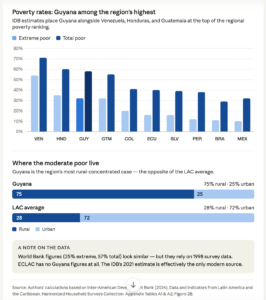
New figures from the Inter-American Development Bank (2024) place Guyana among the poorest countries in Latin America and the Caribbean. An estimated 32% of Guyanese live in extreme poverty and 58% are considered poor overall, rates on par with Venezuela, Honduras, and Guatemala. World Bank numbers tell a roughly similar story (25% extreme, 57% total), but they rely on survey data from 1998, more than two decades old. ECLAC, another major regional source, publishes no poverty figures for Guyana at all. That makes the IDB’s 2021 estimate effectively the only modern benchmark we have for understanding poverty in the country.
What sets Guyana apart isn’t just the scale of poverty, it’s where poverty lives. About 75% of the moderate poor in Guyana reside in rural areas, the highest rural concentration of any country in the regional comparison and the near-mirror opposite of the LAC average, where 72% of the poor live in cities. In most of Latin America, poverty is an urban challenge; in Guyana, it’s overwhelmingly a hinterland one. That geography matters, it shapes where schools, clinics, roads, and jobs programs need to reach, and it suggests that any serious anti-poverty strategy must be built with rural communities at the center, not the periphery.
Source: Authors’ calculations based on Inter-American Development Bank (2024), Data and Indicators from Latin America and the Caribbean, Harmonized Household Surveys Collection. Appendix Tables A1 & A2; Figure 2B.