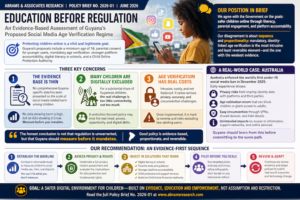
Abrams & Associates Research has released a policy brief examining Guyana’s proposed social media age verification framework and argues that protecting children online is a legitimate and important objective. The report supports measures such as digital literacy education, parental engagement, stronger platform accountability, and enhanced child protection services. However, it questions whether mandatory age verification should be implemented before sufficient evidence has been gathered about the scale and nature of online harms affecting Guyanese children.
The report identifies three key concerns. First, there is currently no comprehensive Guyana-specific data measuring the prevalence of social-media-related harms among children. Second, many Guyanese children continue to face digital exclusion due to limited internet access, shared devices, and high connectivity costs, suggesting that access rather than overexposure remains a challenge for a significant portion of the population. Third, the report points to international experiences, particularly Australia’s recent under-16 social media ban, which has revealed practical challenges related to privacy, age verification accuracy, enforcement, and circumvention.
Rather than making age verification the centerpiece of policy, Abrams & Associates recommends an evidence-first approach. The report calls for a national baseline study on children’s online experiences, an independent privacy impact assessment, expanded digital literacy programs, stronger parental education initiatives, enhanced counseling and child protection services, and pilot testing of any verification system before nationwide implementation. The authors conclude that effective child protection should be built on evidence, education, and empowerment rather than assumptions, emphasizing the importance of measuring the problem before imposing broad regulatory mandates.
Authors:
Karen Abrams
Salima Bacchus-Hinds